Population Ecology · Lewa Wildlife Conservancy · June–July 2025

Four generations of
lions, mapped

Assigned to update Lewa's lion population records and produce a multi-generational family tree. Updated the Excel dataset tracking births, deaths, and lineage — then used RStudio to generate a visualised family tree from the cleaned data.

4
Generations tracked
4
Founding females
13
Females with cub records
50+
Individual lions in dataset

Lion population records as a conservation tool

Individual lion identification and genealogical tracking is a core part of wildlife management at Lewa. Knowing which females are breeding, which lineages are surviving, and how pride structure changes over time allows the research team to assess population health, detect early signs of genetic stress, and understand how predators interact with prey populations across the landscape.

Population records like this are the foundation of evidence-based conservation — without them, management decisions are made blind.

The dataset I was assigned tracks the female lions and cubs they have produced across Lewa, recording births, deaths, paternity, and cub survival across multiple generations. The records needed updating with the most recent data, and the team wanted a visualised family tree to make the generational structure legible at a glance.

Two tasks, one dataset

01

Updating the Excel records

The existing spreadsheet tracked lionesses and their cubs across multiple generations — but needed updating with the most recent births, deaths, cub names, paternity records, and survival statuses. I went through the dataset systematically, cross-referencing field records to fill in missing entries, correct inconsistencies, and add new data for the most recent breeding seasons (2023–2024).

02

Generating the family tree in RStudio

Using the updated Excel dataset as the source, I built a family tree visualisation in RStudio. This involved structuring the parent-offspring relationships as a graph, mapping generational levels, and rendering the lineage in a readable format that the research team could use directly in their reporting. The RStudio output is shown below.

Four generations — interactive

Each node represents an individual lion. Hover for details. Colour indicates survival status. Lines show mother-offspring relationships. Key males — Muffasa, Ntulele, Jacob, Dick, Cat-tail — appear as paternity references.

Alive
Dead
Unknown/unnamed
Founder female

Cubs per female — survival breakdown

The original family tree visualisation

This is the family tree generated directly from RStudio using the updated dataset — the actual deliverable produced during the placement for the research team.

lion_family_tree.R — RStudio output
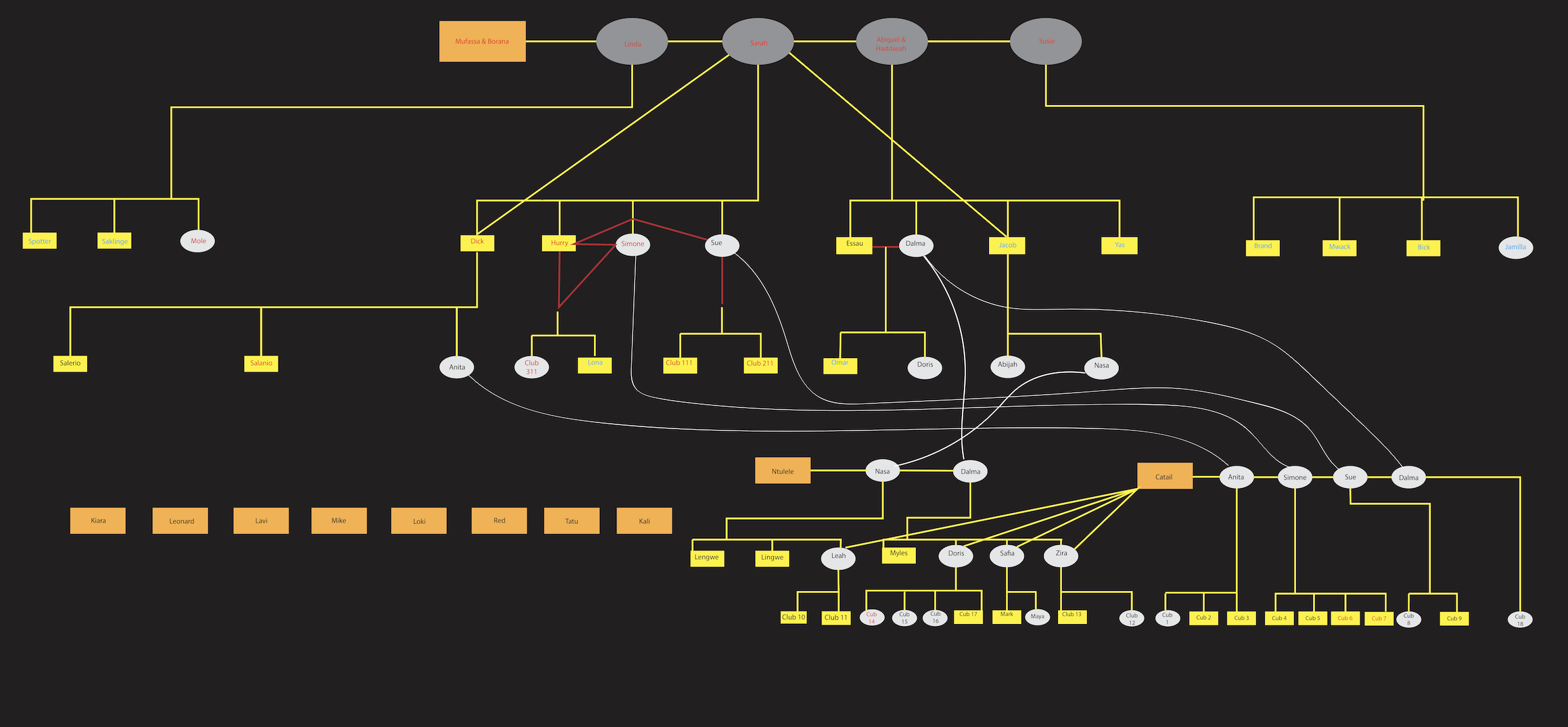
RStudio generated lion family tree

Also from this placement

← All Projects